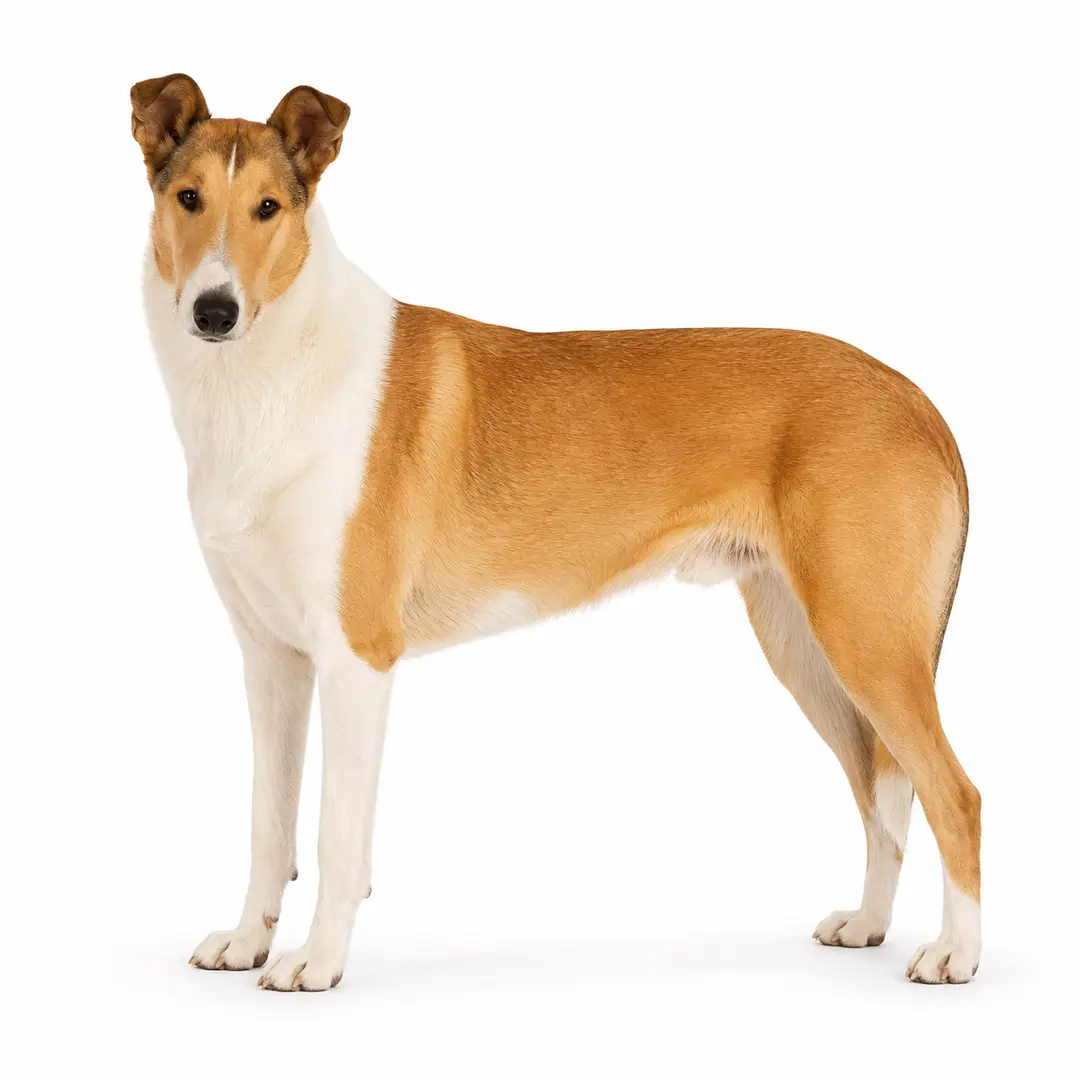
The Smooth Collie is the short-haired variety, or a very close relative within the Collie family according to the registry, and retains the classic expression, intelligence, and herding origin of the Collie without the long coat. It is a medium-sized herding dog from Great Britain, built for activity, cooperation, and correct movement. At home it is usually affectionate, sensitive, and responsive, but needs daily exercise, mental work, quiet handling, and structured socialization.
General details
The FCI recognizes the Smooth Collie as Collie (Smooth), standard number 296, in Group 1, Sheepdogs and Cattledogs, Section 1, without working trial. The FCI standard gives Great Britain as the country of origin and describes the breed as a sheepdog. Males are listed at 56 to 61 cm and 20.5 to 29.5 kg
Breed history in brief
The Collie developed from working sheepdogs of Scotland and northern Britain. The Smooth Collie and Rough Collie share much of their history and type, with the main visual difference being coat length. The Kennel Club notes that nineteenth-century smooth sheepdogs were probably shorter on the leg and more thick-set than modern Smooth Collies, and that later breeding, including influence selected for elegance, brought the smooth and rough varieties closer in outline. Queen Victoria's interest in Collies helped the breed's public profile, and one of her dogs, Sharp, was a Smooth Collie. In 1979, The Kennel Club awarded the first challenge certificates for Smooth Collies as a separate breed. Today the Smooth Collie is seen in conformation, companion homes, performance activities, and some practical work.
Breed characteristics
The Smooth Collie should be balanced, active, and free of coarseness. The head is a clean, blunt wedge, with a flat skull, black nose, almond-shaped eyes, and semi-erect ears that tilt forward when the dog is alert. Expression is an important feature and should convey intelligence and sweetness. The body is slightly longer than tall, with a firm back, deep chest, muscular thighs, and a long tail carried low when at rest. The coat is short, flat, hard in texture, and with a very dense undercoat. It requires regular brushing to remove dead hair, but grooming is quicker than for the Rough Collie. Temperament should be friendly, without nervousness or aggression. The Smooth Collie is typically biddable and a quick learner, but harsh corrections can make it insecure. Positive training, clear routines, and varied exercise suit it well. Many enjoy obedience, rally, agility, scent games, therapy, or long, active walks. As an alert herding dog, it can become very focused on household movements, sounds, and emotions; early socialization helps form stable adults. It normally prefers to live close to people and not isolated outdoors.
Common health problems
Health information for Collies is comparatively well documented. The Kennel Club recommends attention to Collie eye anomaly/choroidal hypoplasia, degenerative myelopathy, multidrug resistance mutation MDR1, progressive retinal atrophy rcd2, and eye testing. The Collie Health Foundation also emphasizes CEA, MDR1, PRA-rcd2, dermatomyositis, and other screening options. MDR1 is especially important because affected dogs can react badly to certain drugs at unsafe doses, so owners should tell every veterinarian that their dog is a Collie and should consider DNA testing. Blue merle is a standard color, but merle-to-merle breeding can produce double-merle puppies with serious hearing or eye defects, so responsible breeders should avoid those matings and use pedigree or DNA color information when needed. Eye exams and DNA tests help breeders reduce risk, but they do not replace ordinary care. A responsible breeder should explain test results clearly for both parents and should avoid producing puppies at high risk for preventable severe disease.
What does genetics say about your pet? Start your journey today.
Get a special 5% discount on your first kit.
Connection error. Please try again later
You have successfully subscribed.
Don't you know your dog's true nature yet?
Unlock the secrets of your pet's DNA with our two ranges.