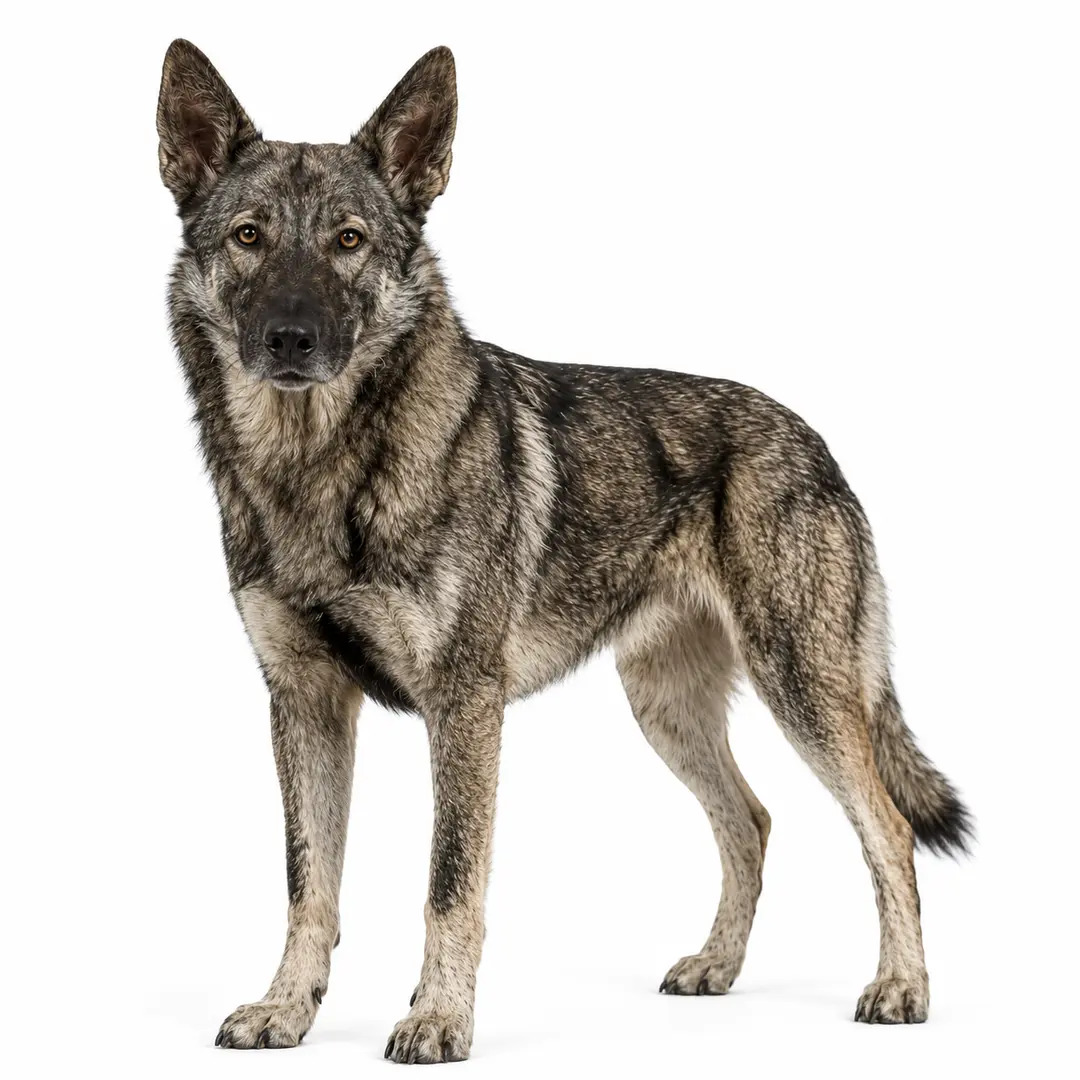
The Giant Lupine, also called Giant Cane Lupine or Luvin, is a rare Italian herding and farm dog from the Apennines of Reggio Emilia. It is especially associated with the mountain area around Monte Cusna, whose local nickname, "Giant," gives the modern name to the breed. It is not an FCI recognized breed and does not appear in ENCI as a fully recognized Italian breed; it is best described as a local population in private conservation. Its interest lies in its rustic and lupoid silhouette, its medium size, its strong attachment to people, and its traditional usefulness with sheep, cattle, farms, and rural homes.
General details
The breed is Italian in origin and belongs functionally with the shepherd and farm-guardian dogs of the northern Apennines. Standard proposals describe a medium-sized, agile, solid dog, slightly longer than tall, with prick ears, a natural tail, a dry build, and a distinctly lupoid expression. Coats may be short or longer, with weather-resistant texture and undercoat
Breed history in brief
The Lupino del Gigante developed as a working dog in the mountain valleys of the Reggio Apennines, where shepherds needed a hardy, quick, attentive dog for livestock and property. Breed accounts describe old "lupini" from isolated valleys such as Costa de' Grassi, Ventasso, Val Bona, and Val d'Asta. As mountain pastoralism declined during the twentieth century, the number of these dogs fell sharply. Since the late 1990s and 2000s, Cristian Ielli and the Cane Lupino del Gigante association have worked to identify surviving dogs, protect them from crossbreeding, and rebuild a coherent population. A proposed standard by Antonio Crepaldi, an ENCI/FCI judge, summarizes morphology and historical research, but it remains a recovery project rather than a broadly recognized kennel-club breed.
Breed characteristics
It is a lively, alert, and rustic dog, with a strong bond with its family. Traditional descriptions highlight an affectionate nature with its own, often playful in youth, but watchful and territorial upon maturing. It needs clear handling, early socialization, and daily work or structured activity. It is not a low-maintenance urban pet: it was shaped by open spaces, livestock, movement, and close cooperation with people. A good home should offer secure fencing, mental tasks, recall training, and careful introductions to strangers and other animals. Coat care is usually moderate, with more brushing during seasonal sheds and more attention for long-haired specimens. Being a small population, temperament and type can vary more than in established international breeds.
Common health problems
Published breed-specific health data is very limited. Conservation sources present the Lupino del Gigante as a naturally selected rustic dog, but rarity itself is a health concern because small populations can lose genetic diversity. Sensible screening should include veterinary checks for hips, elbows, patellas, eyes, teeth, testicles in males, and general soundness before breeding. As a medium working dog, it may still face orthopedic injuries, hip dysplasia, skin problems, parasites, and tick-borne disease if it lives outdoors. Responsible breeding should avoid close matings and exclude dogs with abnormal behavior, serious structural faults, or inherited disease. Owners should keep the dog lean, condition exercise gradually, and build a preventive plan with a veterinarian.
What does genetics say about your pet? Start your journey today.
Get a special 5% discount on your first kit.
Connection error. Please try again later
You have successfully subscribed.
Don't you know your dog's true nature yet?
Unlock the secrets of your pet's DNA with our two ranges.