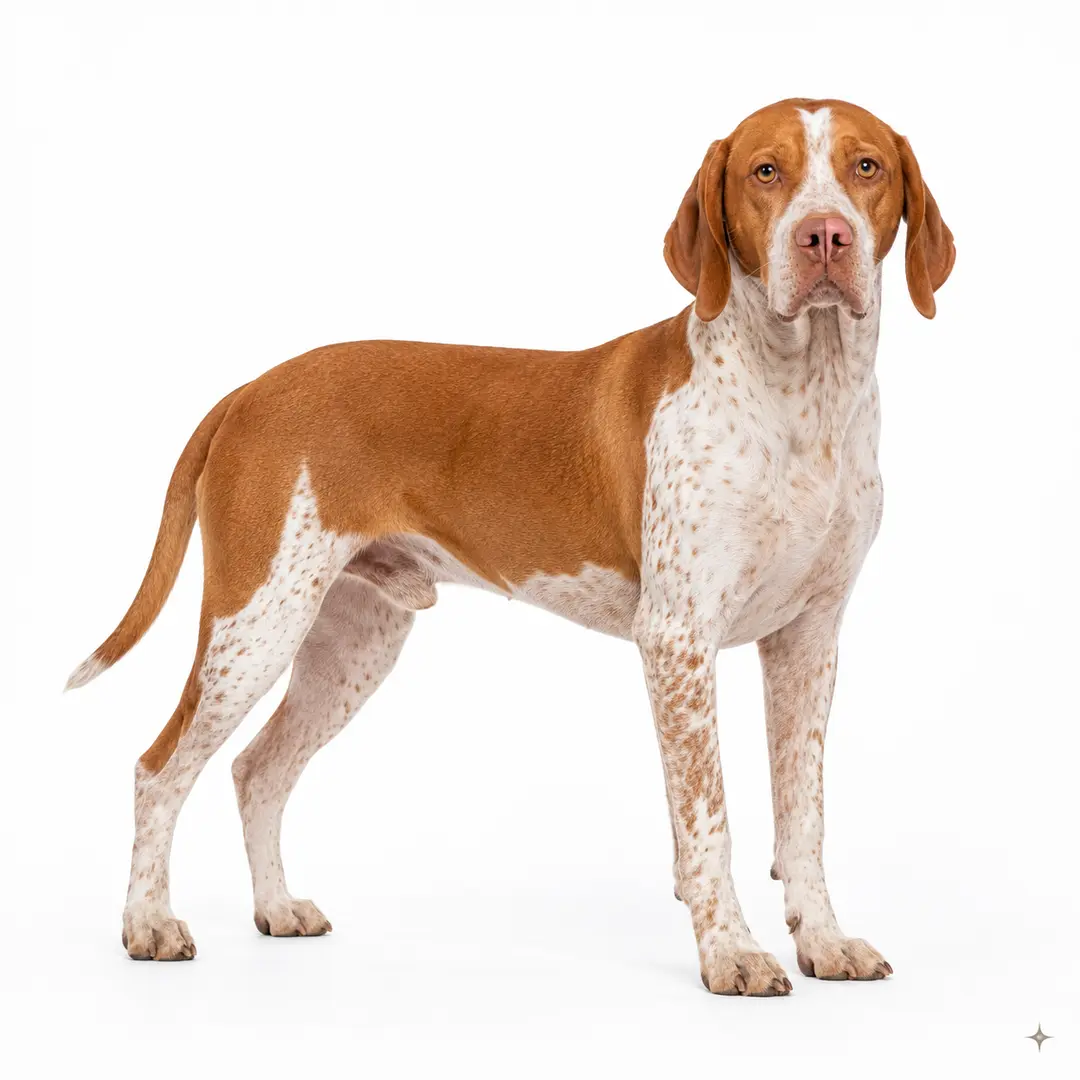
The Catalburun, also called Tarsus Catalburun or Turkish Pointer, is a rare pointing dog from southern Turkey. It is mostly associated with Tarsus, in Mersin, where it has been used for partridge and other feathered game. Its most well-known trait is its split or bifid nose, but the breed should not be reduced to that single characteristic. In its homeland, it is valued as a practical hunting dog: alert, olfactory, loyal to its handler, and capable of working in hot and dry terrain. It is not listed as a recognized breed by the FCI, and published information remains limited compared to other international pointing dogs.
General details
The Catalburun is generally a medium, athletic dog, moderately boned, short-haired, drop-eared, and with a functional field silhouette. Published measurements vary because there is no widely used international standard, but most descriptions place it as a compact pointer, not a large dog. The coat is short and smooth, commonly white with brown, liver, orange, or tan markings, sometimes with ticking or patches. The split nose is the visible hallmark of the breed. It is a separation of the nasal plane, not two complete noses. Breeders and hunters should prioritize sound structure, normal respiration, a good bite, scenting ability, and temperament over extreme appearance. The breed needs daily exercise and mental work. Scent games, field training, long walks, recall, and secure runs suit it better than a quiet indoor routine.
Breed history in brief
The written record of the breed is small, but Turkish veterinary sources identify it as a rare local hunting dog originating from Tarsus. A 2012 article described it as linked to Tarsus, rare outside of it, and neither standardized nor officially recognized then. The same sources highlight its use as a partridge hunter and its very reduced population. The Catalburun is sometimes compared to the Spanish Pachón Navarro because both can present a split nose. A direct relationship is possible, but not well proven, so it is more prudent to describe it as part of the Mediterranean pointing dog tradition and, at the same time, emphasize its Turkish regional identity. Modern interest focuses on documenting and conserving it, because a small population can be lost through uncontrolled crosses or by breeding solely for rarity.
Breed characteristics
The Catalburun should appear agile, balanced, and ready to work. Its body is muscular without heaviness, with enough chest for stamina and enough leg to cover uneven ground. The head is fairly long, the eyes are usually amber to brown, and the expression is attentive and gentle. The coat needs only simple care: weekly brushing, nail trimming, dental care, parasite prevention, and regular ear checks. Temperament is usually described as loyal, intelligent, trainable, and people-oriented with its family. In the field it is expected to search, locate scent, point, and wait for the hunter. At home, that same focus can become restlessness if the dog has no work. Early socialization with people, dogs, livestock, poultry, and normal household activity is important. Prey drive may be high, so small pets require caution. Positive, consistent training works better than harsh handling.
Common health problems
Studies of the Catalburun's specific health are scarce, so health claims should be cautious. Rarity does not guarantee health. Practical control should focus on general risks for medium-sized sporting dogs and known issues within each breeding line. Potential concerns include hip dysplasia, elbow problems, ear infections from floppy ears, dental disease, allergies, eye conditions, and hunting injuries. As the population is small, inbreeding and loss of genetic diversity are also concerns. Buyers should inquire about lineage, longevity, orthopedic and eye reviews, and causes of death in relatives. The split nose is a breed trait, but extreme facial anomalies should not be excused: a healthy Catalburun must breathe, eat, smell, and move normally.
What does genetics say about your pet? Start your journey today.
Get a special 5% discount on your first kit.
Connection error. Please try again later
You have successfully subscribed.
Don't you know your dog's true nature yet?
Unlock the secrets of your pet's DNA with our two ranges.