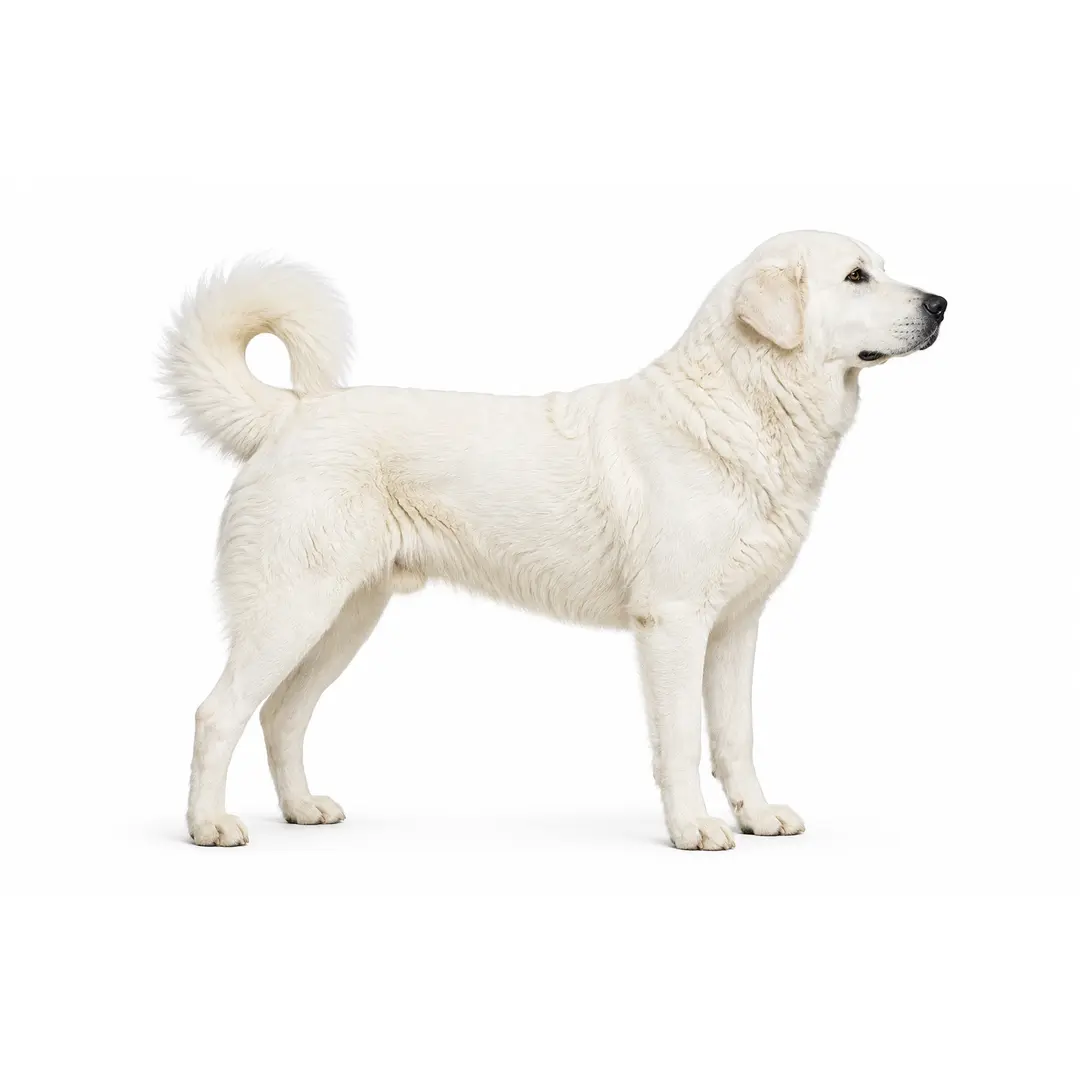
The Akbash is a large livestock guardian dog from Turkey, developed to live with sheep and goats and deter predators with stability, size, and security. Its traditional job is to protect the flock with patience and independence in large rural spaces. The breed is usually calm when nothing is happening, but it is alert to changes in its territory and can make decisions without constant orders. Therefore, it fits best with people experienced with guardian breeds, secure space, and early socialization.
General details
The Akbash is recognized by the United Kennel Club, which places it among guardian breeds, and KIF lists Akbaş Çoban Köpeği among Turkish local breeds. It is not listed as a definitively recognized FCI breed in the FCI nomenclature. UKC describes males as about 30 to 34 inches (76 to 86 cm) at the withers and females about 28 to 32 inches (71 to 81 cm), with working-condition weights around 120 pounds (54 kg) for males and 90 pounds (41 kg) for females. The body is slightly longer than tall, lean rather than bulky, and built to combine power with speed and agility. The coat is always white, sometimes with light biscuit or gray shading around the ears or in the undercoat. Two coat lengths are accepted, both with a dense undercoat that changes with climate.
Breed history in brief
The breed comes from western Turkey, where villagers and shepherds used white guardian dogs to protect flocks from wolves and other predators. Its exact origin is old and not fully documented, but UKC presents it as Turkey's counterpart to the white livestock guardian dogs found around the northern Mediterranean. Modern recognition outside Turkey was shaped by the work of David and Judy Nelson, who studied and imported Akbash dogs from Turkey in the 1970s. Their imports became foundation stock in North America, and the United States Department of Agriculture later used Akbash dogs in predator-control work. UKC recognized the breed in 1998. The Akbash remains closely tied to livestock protection, and that working background should guide expectations about temperament, training, and management.
Breed characteristics
An Akbash should look strong, clean, and athletic rather than heavy. The head is wedge-shaped with pendant ears, almond-shaped brown eyes, strong jaws, and dark pigmentation on the nose, eye rims, and lips. The chest is deep, the legs are long, and the tail is carried low at rest but often curls over the back when the dog is moving or excited. The white double coat sheds seasonally and needs regular brushing, especially when the undercoat is coming out or when a long-coated dog works in rough vegetation. The breed's temperament is defined by calm watchfulness. A good Akbash is steady, independent, courageous, and strongly bonded to the animals or people it considers its responsibility. It should not be sharp or frantic, but it may be reserved with strangers and naturally suspicious of unfamiliar dogs or predators near its territory. Puppies need careful, positive exposure to people, livestock, handling, vehicles, veterinary care, and ordinary household routines. Training should focus on trust, boundaries, recall foundations, leash manners, and safe management
Common health problems
Published breed-specific health data for the Akbash is limited compared with common kennel-club breeds. Practical health planning should therefore start with the risks typical of large, deep-chested, fast-growing dogs. Hip dysplasia is a concern in large breeds, so responsible breeders should use orthopedic screening such as OFA or PennHIP and should avoid rapid growth or excess weight in puppies. Gastric dilatation-volvulus, or bloat, is a life-threatening emergency seen more often in large, deep-chested dogs
What does genetics say about your pet? Start your journey today.
Get a special 5% discount on your first kit.
Connection error. Please try again later
You have successfully subscribed.
Don't you know your dog's true nature yet?
Unlock the secrets of your pet's DNA with our two ranges.